
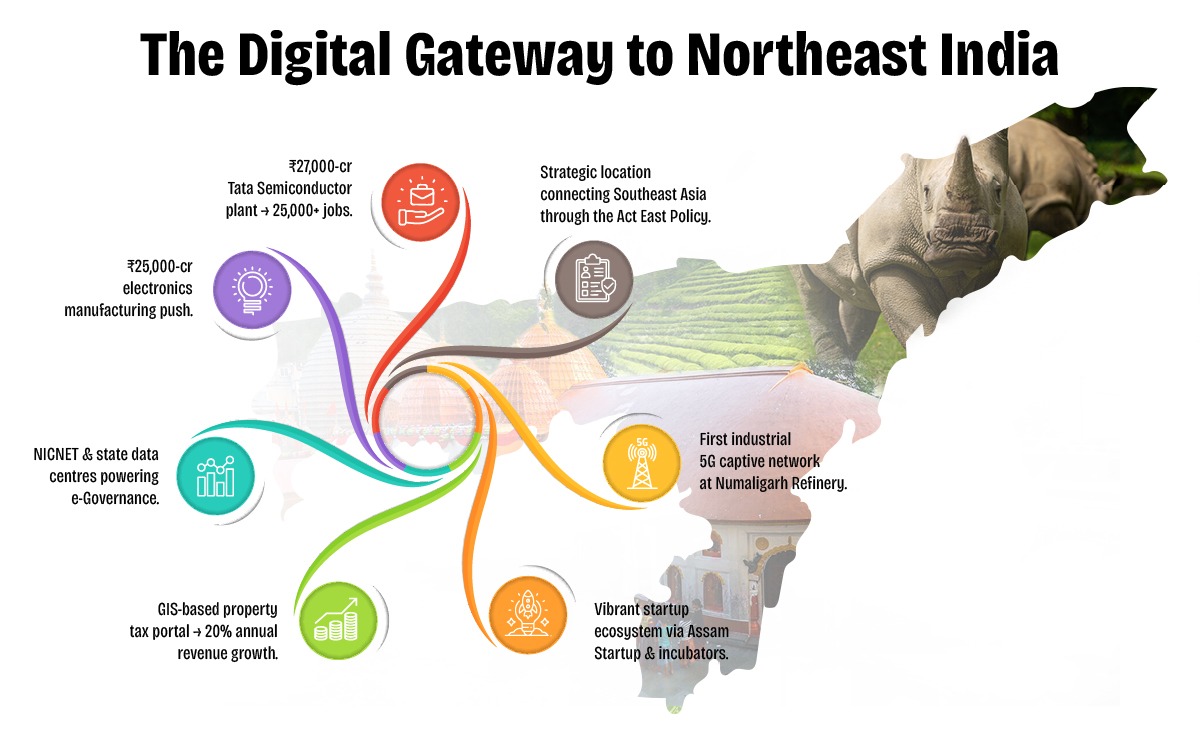
Assam is rapidly emerging as a digital innovation hub in Northeast India, driven by visionary policies and proactive governance under the Digital Assam initiative. With a growing IT ecosystem, expanding digital infrastructure, and a strong focus on e-Governance, the state is positioning itself at the forefront of India's digital transformation.
To further accelerate this journey, Elets Technomedia, in collaboration with the Information Technology Department, Government of Assam, is organising the National Digital Innovation Summit 2025 on 5-6 December in Guwahati. The summit will provide a platform for policymakers, industry leaders, innovators, and technologists to deliberate on strategies to advance the state's digital progress.

Sessions

Dynamic Speakers

of Special eGov Magazine

featuring cutting-edge solutions

Networking
An Initiative By

Knowledge Partner

Host Partner

Supporting Partner

Powered By

Banking Partner

Gold Partners


Digital Transformation Partner

Secured Communications Technology Partner

Associate Banking Partner

Technology Partner

Data Center Partner

E-Governance Partner

Branding Partners




Supporting Partners



Spectral estimation is a crucial aspect of signal processing, as it allows us to analyze and understand the frequency content of a signal. The goal of spectral estimation is to estimate the power spectral density (PSD) of a signal, which describes how the power of the signal is distributed across different frequencies. Traditional methods of spectral estimation, such as the periodogram and Welch’s method, have been widely used for decades. However, these methods have limitations, such as low resolution and high variance, which can lead to inaccurate estimates.
In conclusion, modern spectral estimation theory and applications have undergone significant developments in recent years, offering improved accuracy, resolution, and computational efficiency. This article has provided an overview of modern spectral estimation techniques, including Welch’s method with modern windowing techniques, multitaper spectral estimation, EVD-based methods, and sparse spectral estimation. The applications of modern spectral estimation have been highlighted, including signal processing, biomedical engineering, seismology, and communication systems. Finally, the theoretical foundations and challenges of modern spectral estimation have been discussed, highlighting the need for further research and development in this field.
Spectral estimation is a fundamental concept in signal processing, which involves estimating the distribution of power or energy across different frequencies in a signal. The field of spectral estimation has undergone significant developments over the years, with modern techniques offering improved accuracy, resolution, and computational efficiency. In this article, we will provide an overview of modern spectral estimation theory and its applications, highlighting the latest advancements and trends in the field.
Digital Transformation in Governance
Startups, Innovations & Entrepreneurial Growth in Northeast India
Artificial Intelligence (AI) for Inclusive Growth
Cloud, Data & Cybersecurity for a Secure Digital Future
Digital Infrastructure & Connectivity in Northeast India
Skilling, Capacity Building & Future Workforce Development
E-Governance & Citizen-Centric Service Delivery
Spectral estimation is a crucial aspect of signal processing, as it allows us to analyze and understand the frequency content of a signal. The goal of spectral estimation is to estimate the power spectral density (PSD) of a signal, which describes how the power of the signal is distributed across different frequencies. Traditional methods of spectral estimation, such as the periodogram and Welch’s method, have been widely used for decades. However, these methods have limitations, such as low resolution and high variance, which can lead to inaccurate estimates.
In conclusion, modern spectral estimation theory and applications have undergone significant developments in recent years, offering improved accuracy, resolution, and computational efficiency. This article has provided an overview of modern spectral estimation techniques, including Welch’s method with modern windowing techniques, multitaper spectral estimation, EVD-based methods, and sparse spectral estimation. The applications of modern spectral estimation have been highlighted, including signal processing, biomedical engineering, seismology, and communication systems. Finally, the theoretical foundations and challenges of modern spectral estimation have been discussed, highlighting the need for further research and development in this field.
Spectral estimation is a fundamental concept in signal processing, which involves estimating the distribution of power or energy across different frequencies in a signal. The field of spectral estimation has undergone significant developments over the years, with modern techniques offering improved accuracy, resolution, and computational efficiency. In this article, we will provide an overview of modern spectral estimation theory and its applications, highlighting the latest advancements and trends in the field.
















































& many more...
Ritika Srivastava
+91- 9990108973Anuj Sharma
+91- 8860651650
© 2026 Nova Signal. All rights reserved.
Elets Technomedia, a leading technology research and media organisation, has established a robust global presence since 2003, expanding across India, Malaysia, Sri Lanka, Bangladesh, the UK, the Middle East, and beyond. Driven by a vision to explore new frontiers in tech-led innovation for a better world, Elets pioneers impactful knowledge-sharing platforms, including global conferences, webinars, and research-driven publications. Bringing together the finest policymakers and industry leaders, Elets creates impactful synergies to drive a future-ready world.



COPYRIGHT © 2025. ALL RIGHTS RESERVED BY ELETS TECHNOMEDIA PVT LTD.